
Learning Flexible Generalization in Video Quality Assessment by Bringing Device and Viewing Condition Distributions
Video quality assessment (VQA) plays a critical role in optimizing video delivery systems. Perceived quality strongly depends on viewing conditions and display characteristics — factors such as ambient lighting, display brightness, and resolution significantly influence the visibility of distortions.
We address multi-screen quality assessment on mobile devices, an area that remains largely under-covered. We introduce the first large-scale subjective dataset collected across more than 300 different Android devices, accompanied by metadata on viewing conditions and display properties. We propose a strategy for aggregated score extraction and adaptation of VQA models to device-specific quality estimation.
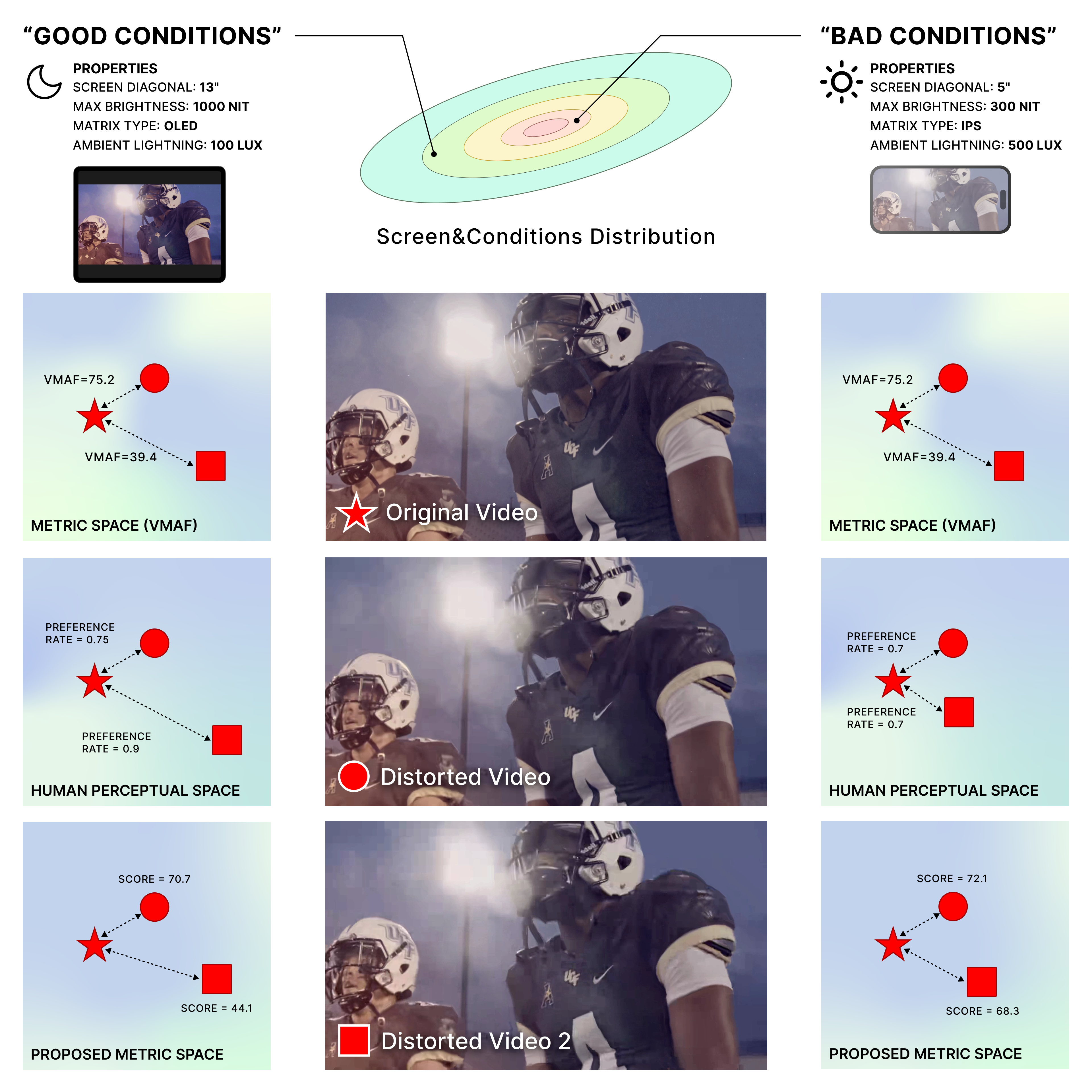
Our results demonstrate that incorporating device and context information enables more accurate and flexible quality prediction, offering new opportunities for fine-grained optimization in streaming services.
Access to the Mobile Device VQA Dataset is provided by request. Please fill in the form, and we will contact you with access details.
Cite us
@inproceedings{safonov2026mobilevqa,
  author    = {Nickolay Safonov and Dmitriy Vatolin},
  title     = {Learning Flexible Generalization in Video Quality Assessment by Bringing Device and Viewing Condition Distributions},
  booktitle = {Proceedings of the 43rd International Conference on Machine Learning},
  series    = {Proceedings of Machine Learning Research},
  year      = {2026},
  publisher = {PMLR},
  url       = {https://icml.cc/virtual/2026/poster/63617}
}